
China Best Commercial LED Lamps Suppliers for Buyers?
Choosing China Best Commercial LED Lamps Suppliers for Buyers? The question matters because lighting affects operating costs, visual comfort, and maintenance schedules. Commercial Led Lamps now serve warehouses, offices, retail floors, and outdoor sites. Yet supplier directories rarely show how a product performs after installation.
The U.S. Department of Energy reports that LEDs use at least 75% less energy and last up to 25 times longer than incandescent lighting. These figures provide useful context, not a direct promise for every commercial fixture. Actual results depend on wattage, optics, operating hours, dimming controls, heat management, and installation quality. Small details matter. A warehouse high-bay lamp with poor glare control can still leave workers uncomfortable, even when its energy figures look attractive.
This guide considers suppliers through practical buyer checks: product specifications, test documentation, warranty terms, sample evaluation, and communication after shipment. The International Energy Agency’s energy-efficiency analysis also underscores the wider value of efficient lighting, while reminding buyers that efficiency improvements require real-world adoption. Ask for verifiable photometric data and confirm that reported values match the exact model offered. Compare comparable products, not just catalog claims. A supplier may quote an impressive efficacy figure, but the fixture’s delivered light and service support deserve equal attention. There is no perfect shortlist for every project; this guide offers a starting point, not a guarantee.
Understanding China’s Commercial LED Lamp Supplier Landscape
Understanding China’s Commercial LED Lamp Supplier Landscape
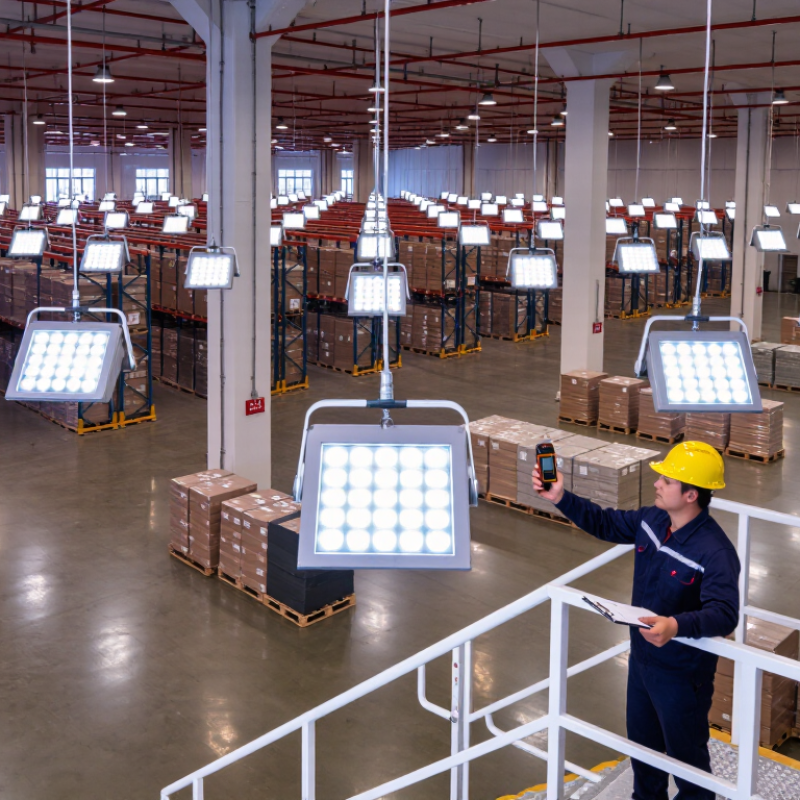
China’s commercial LED lamp suppliers vary in production scale, technical focus, and export experience. Some concentrate on high-volume downlights and panels, while others handle project-specific fixtures or smaller custom runs. A polished catalog is only a starting point. Buyers should compare product specifications, factory capabilities, and communication quality before requesting a quotation. Ask for details such as lumen output, color temperature, driver type, and operating temperature. These affect how a lamp performs in an actual shop, office, or warehouse. Sample testing helps reveal differences that product photos cannot show. Still, one sample may not reflect every production batch.
Tips: Request test reports tied to the exact model, and confirm what the report measures. Clarify minimum order quantities, sample costs, lead times, packaging, and the process for handling defects. Ask whether components or specifications may change between orders. Keep written records. Vague answers are worth revisiting.
Supplier comparisons can take time, especially when specifications use different testing methods. That part is easy to underestimate. A lower quoted price may also exclude tooling, special packaging, or inspection costs. Review the full offer, not just the unit price. Where possible, use an independent inspection before shipment and verify that delivered products match the approved sample. No checklist removes every risk, but clear specifications and documented checks make sourcing decisions more dependable.
China Best Commercial LED Lamps Suppliers for Buyers? – Understanding China’s Commercial LED Lamp Supplier Landscape
A practical comparison of supplier profiles and buyer checks. These are general market categories, not a company ranking; capabilities vary by factory and product.
| Supplier profile | Common commercial LED products | Often suitable for | What buyers should verify | Relevant standards and checks |
|---|---|---|---|---|
| OEM / ODM luminaire manufacturer | Panel lights, downlights, linear fixtures, and other indoor luminaires; some offer custom housing, optics, or packaging. | Importers and project buyers needing a defined specification or product customization. | Confirm which parts are made in-house, sample-to-production consistency, customization limits, tooling ownership, and change-control procedures. | Request reports for the exact model and configuration. IEC 60598 is a relevant luminaire safety series; market-specific requirements still apply. |
| High-bay and industrial lighting supplier | High-bay and low-bay luminaires, industrial linear lights, and fixtures designed for demanding indoor environments. | Warehouses, factories, logistics facilities, and other large commercial spaces. | Check photometric files, thermal design, mounting options, operating temperature, ingress-protection claims, and compatibility with controls. | For US projects, check applicable safety listing requirements and whether a specific product appears in the relevant rebate or qualification directory. Listings are model-specific. |
| Outdoor and area-lighting supplier | Roadway, parking-area, flood, and other outdoor luminaires, sometimes with photocell or dimming options. | Municipal, infrastructure, commercial-site, and outdoor retrofit projects. | Review corrosion resistance, surge protection, optical distribution, wind or mounting requirements, environmental ratings, and maintenance access. | Confirm the applicable local electrical and environmental requirements, and obtain test documentation for the exact luminaire and accessories. |
| Commercial retrofit-lamp supplier | LED tubes, retrofit lamps, and replacement products intended for existing fixtures. | Buyers replacing lamps while retaining some or all existing luminaires. | Check compatibility with ballast or direct-wiring arrangements, installation instructions, socket type, and any required fixture modifications. | Verify electrical safety and local-market compliance for the exact retrofit type; do not assume compatibility from lamp shape alone. |
| Project-focused lighting supplier | A mix of luminaires and accessories selected for a project, potentially sourced from multiple manufacturing facilities. | Contractors, distributors, and buyers coordinating several product types or delivery lots. | Identify the actual factory for each item, clarify who handles warranty and quality claims, and confirm that replacements will match the approved specification. | Check compliance documents by product and destination market; a supplier’s general certificate does not establish compliance for every item. |
| Driver or component-focused supplier | LED drivers, control gear, modules, or related components used in commercial luminaires. | Luminaire manufacturers and technical buyers with a defined electrical or integration requirement. | Confirm electrical ratings, dimming protocol, flicker data, thermal limits, protection features, and compatibility with the selected LED module. | IEC 61347 is a relevant controlgear safety series. Check the applicable part and edition for the product and destination market. |
Buyer note: CE marking and RoHS documentation may be relevant for products placed on the EU market; UL or ETL certification may be relevant to North American projects, depending on the product and applicable rules. Ask for current, verifiable documents tied to the exact model. Compare photometric data, warranty terms, sample quality, and written specifications before placing a production order.
Related Posts
-
Revolutionizing Energy Efficiency: The Future of LED Lighting in Smart Homes and Offices
-

Discovering Top-Notch Suppliers for Your LED Lamps: A Comprehensive Guide
-

Navigating Tariff Challenges: China’s Resilient Growth in Best Led Fixtures Amidst US-China Trade Tensions
-
Unwavering Quality in Best Led Lamps Made in China Trusted Worldwide
-
How to Choose the Right LED Fixtures for Energy Efficiency: Insights and Data for Smart Lighting
-
2026 How to Choose the Right LED Fixtures for Your Home Lighting Needs?